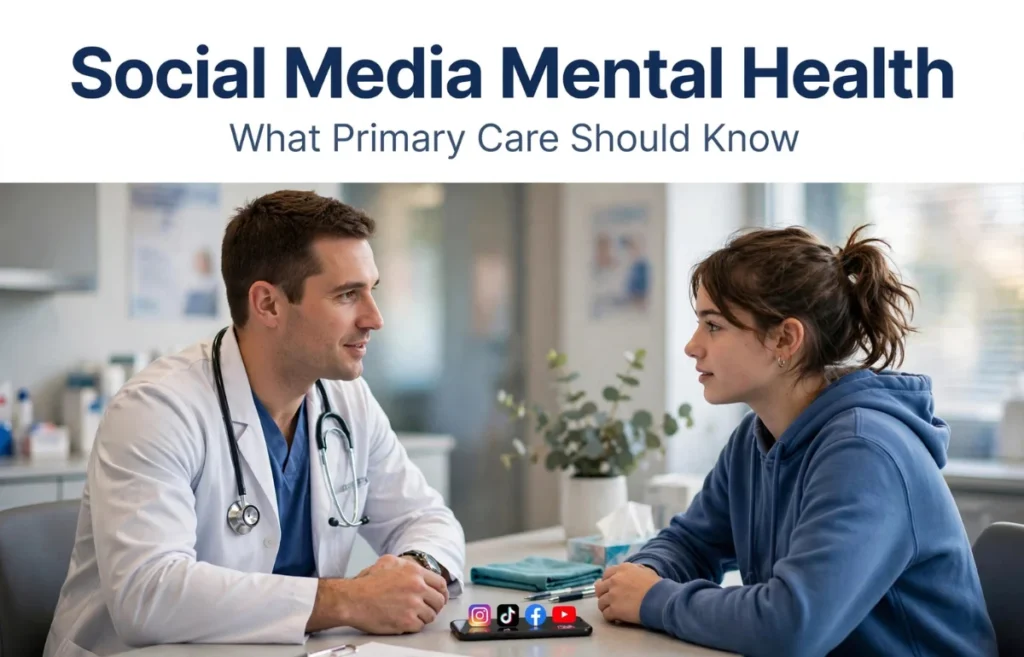
Social media has become an important part of everyday life. For adolescents and adults alike, platforms such as Instagram, Facebook, TikTok, and others provide opportunities for communication, entertainment, education, and social connection.
At the same time, concerns about the relationship between social media use and emotional well-being have become increasingly difficult for healthcare providers to ignore. Excessive or problematic use may be associated with sleep disruption, anxiety, depression, cyberbullying, social comparison, body-image concerns, and other challenges.
These concerns recently received significant legal attention in New Mexico, where litigation involving Meta examined alleged harms associated with Facebook and Instagram. The case has brought renewed attention to social media mental health concerns and raises an important question for healthcare organizations: Should primary care providers pay closer attention to how digital experiences may be affecting their patients?
For many practices, incorporating social-media-related questions into broader mental-health conversations may provide useful clinical context.
What Happened in the New Mexico Meta Case?
In March 2026, a New Mexico jury found Meta liable under the state’s consumer-protection laws in a case focused on the safety of its platforms and alleged harms involving young users. The jury imposed $375 million in civil penalties.
The case entered another significant phase in August 2026 when a New Mexico judge ruled that Meta had created a public nuisance and ordered the company to pay $567 million into a fund intended to support youth mental-health prevention and treatment.
The ruling also included measures concerning younger users, including protections related to notifications, age verification, usage restrictions, and interactions involving AI chatbots.
Meta has disputed claims that its platforms harmed young people or misled the public and has said it intends to appeal.
The ruling should not be interpreted as evidence that every person who uses social media will experience psychological harm. Digital platforms can also provide community, education, support networks, and meaningful social interaction.
However, the case demonstrates that concerns about the effects of platform design and online engagement on younger users have become significant issues for healthcare professionals, policymakers, families, schools, and courts.
Potential Mental Health Concerns Associated With Social Media
Social media affects each person differently. Factors such as age, emotional health, online experiences, family environment, time spent online, and the type of content consumed can all influence outcomes.
The following table highlights several issues healthcare providers may want to explore when discussing social-media habits with patients.
| Social Media Factor | Possible Mental Health or Wellness Concern | Questions Providers May Consider |
|---|---|---|
| Late-night scrolling | Poor sleep, fatigue, difficulty concentrating | Is social media interfering with sleep? |
| Cyberbullying | Anxiety, depression, social withdrawal | Has anyone harassed or bullied you online? |
| Social comparison | Low self-esteem, body-image concerns | Does viewing other people’s posts affect how you feel about yourself? |
| Excessive use | Reduced physical activity or disruption to daily routines | Does social media interfere with school, work, relationships, or exercise? |
| Distressing content | Fear, anxiety, emotional distress | Do you regularly encounter content that makes you feel upset or unsafe? |
| Compulsive checking | Stress or difficulty controlling usage | Do you find it difficult to reduce your social-media use? |
These factors do not necessarily mean social media is causing a psychiatric condition. Instead, they can serve as useful discussion points within a broader mental-health assessment.
Why Social Media Belongs in the Primary Care Conversation

Primary care professionals are often among the first healthcare providers to recognize changes in a patient’s emotional or behavioral health.
A teenager might visit a physician because of fatigue but reveal that they routinely stay awake late at night using social media. Another patient may describe anxiety that becomes noticeably worse after reading comments, comparing themselves with others online, or experiencing cyberbullying.
In other cases, patients may encounter unwanted contact, harmful content, social pressure, or concerns surrounding appearance and popularity.
Healthcare providers should not automatically assume that social media is responsible for depression, anxiety, or another mental-health condition. Mental health is influenced by numerous biological, psychological, environmental, family, and social factors.
However, asking patients about their online experiences can reveal important information that might otherwise be missed during a routine visit.
A balanced approach is particularly important. Digital communication is not inherently harmful, and many people benefit from the social connections and communities they find online.
The goal should therefore be to understand whether a patient’s digital habits are supporting or interfering with their overall well-being.
What Can Primary Care Providers Ask?
Social-media screening does not necessarily require an entirely new questionnaire. In many situations, a few nonjudgmental questions can complement existing behavioral-health screening procedures.
Providers might ask:
- Does social media interfere with your sleep, school, work, exercise, or relationships?
- How do you usually feel after spending time on social-media platforms?
- Have you experienced cyberbullying, harassment, or unwanted contact online?
- Do online posts affect how you feel about your appearance or self-worth?
- Have you encountered content online that causes fear, anxiety, or emotional distress?
- Do you have difficulty limiting your social-media use?
The objective is not simply to calculate screen time. Context matters.
For example, a person who spends several hours communicating with friends online but continues to maintain healthy sleep, relationships, work, school, and physical activity may have a very different risk profile from someone whose digital habits are disrupting important parts of daily life.
Recognizing When Additional Mental Health Support May Be Needed
Social-media discussions may uncover symptoms that require further evaluation.
Some warning signs can include persistent anxiety, worsening depression, severe sleep disruption, significant withdrawal from family or friends, dramatic behavioral changes, declining school or work performance, or statements indicating self-harm or suicidal thoughts.
Primary care providers can use their existing behavioral-health protocols to determine the appropriate next step.
The table below illustrates one possible care pathway.
| Primary Care Finding | Possible Next Step | Role of Behavioral Health Support |
|---|---|---|
| Mild concerns without major impairment | Education, follow-up, healthy digital habits | Monitor symptoms and functioning |
| Persistent anxiety or depressive symptoms | Behavioral-health screening and assessment | Therapy or psychiatric consultation may be appropriate |
| Significant functional impairment | Refer for specialized mental-health evaluation | Psychiatric assessment and treatment planning |
| Medication-related psychiatric needs | Psychiatric consultation | Evaluation and medication management when appropriate |
| Immediate safety concerns | Follow established emergency and safety procedures | Urgent psychiatric or emergency intervention |
The exact response should always depend on the individual patient, clinical judgment, and the healthcare organization’s established procedures.
Screening Is Only Helpful When There Is a Path to Care

Identifying a potential mental-health concern is only the first step.
A more difficult challenge arises when a primary care provider determines that a patient may benefit from psychiatric evaluation but specialized services are difficult to access.
Traditional referral systems can create delays. Patients may need to contact several psychiatric practices, join waiting lists, travel long distances, or navigate unfamiliar healthcare systems.
Access can be particularly difficult in rural areas and communities experiencing shortages of psychiatric professionals.
For primary care organizations, this creates a practical challenge. Screening may identify an important need, but without an effective referral pathway, patients can still experience delays in receiving specialized care.
Telepsychiatry can help healthcare organizations address this gap.
How Telepsychiatry Can Support Existing Medical Systems
Telepsychiatry allows psychiatric professionals to evaluate and treat patients remotely using secure telemedicine technology.
For healthcare organizations, one of the major advantages is the ability to expand psychiatric capacity without necessarily creating a full in-house psychiatry department.
Organizations using telepsychiatry services can establish a clearer pathway for patients whose behavioral-health screening indicates that specialized psychiatric evaluation may be appropriate.
FasPsych works with healthcare organizations, including primary care providers, to provide psychiatric staffing and telemedicine support. Depending on the needs of a healthcare system, psychiatric professionals may assist with evaluations, medication management, ongoing care, and collaboration with existing medical teams.
Consider a primary care clinic where an adolescent reports worsening anxiety, sleep problems, and emotional distress related to online experiences.
The primary care clinician can evaluate immediate safety concerns, use the practice’s established behavioral-health screening process, and determine whether specialist evaluation is warranted.
If a telepsychiatry pathway is already integrated into the healthcare organization, the patient may have a more direct route to psychiatric assessment rather than receiving only a list of outside specialists to contact independently.
The same approach can also benefit adult patients experiencing anxiety, depression, compulsive behavior, sleep problems, or other concerns associated with their digital habits.
Integrating Mental Health Referrals Without Rebuilding the Practice
Telepsychiatry is not intended to replace primary care. Instead, psychiatric professionals can complement the care provided by physicians, nurse practitioners, physician assistants, therapists, and care coordinators.
A healthcare organization can create a relatively straightforward workflow:
- Include appropriate questions about digital habits during relevant patient visits.
- Continue using established depression, anxiety, and safety-screening tools.
- Identify clear criteria for when psychiatric consultation is appropriate.
- Establish a reliable referral pathway for specialized mental-health care.
- Coordinate treatment information between primary care and psychiatric professionals when appropriate.
This approach allows primary care to remain the patient’s familiar point of contact while making specialized psychiatric expertise more accessible.
For rural practices, community health organizations, hospitals, and medical groups experiencing psychiatric staffing shortages, telepsychiatry can provide additional flexibility.
The New Mexico Ruling Is a Reminder for Healthcare Providers
The New Mexico Meta litigation will continue to attract attention, particularly because Meta has indicated that it intends to appeal.
Regardless of the ultimate legal outcome, the broader healthcare issue remains relevant.
Digital environments are now a significant part of patients’ everyday lives. Their online experiences can potentially influence sleep, mood, anxiety, self-esteem, relationships, and daily functioning.
Primary care providers do not need to assume that social media causes every mental-health symptom. Instead, clinicians can recognize digital habits as one of many factors worth discussing when evaluating a patient’s overall well-being.
When those conversations reveal a need for specialized psychiatric care, an effective referral pathway becomes equally important.
Combining thoughtful primary care screening with accessible specialist support through telepsychiatry may help healthcare organizations move more efficiently from identifying potential concerns to providing appropriate mental-health care.
Frequently Asked Questions
1. Can social media negatively affect mental health?
Social media can affect people in different ways. Problematic or excessive use may be associated with issues such as anxiety, poor sleep, social comparison, depression, cyberbullying, or low self-esteem in some individuals. However, social media can also provide positive social connections, support communities, education, and entertainment. Individual circumstances and patterns of use matter.
2. Should primary care providers ask patients about social media use?
Questions about social-media habits can provide useful context when providers are evaluating sleep problems, anxiety, depression, behavioral changes, or other mental-health concerns. These questions can be incorporated into broader discussions about lifestyle and emotional well-being rather than treated as a standalone diagnosis.
3. What signs may indicate that social media is affecting a patient’s well-being?
Possible signs include sleep disruption, persistent anxiety, reduced self-esteem, withdrawal from family or friends, declining school or work performance, emotional distress after using social platforms, cyberbullying, or difficulty reducing social-media use.
4. How can telepsychiatry help primary care practices?
Telepsychiatry can give primary care organizations access to psychiatric professionals through secure remote care. Depending on the care model, psychiatric providers may assist with assessments, medication management, treatment planning, follow-up care, and collaboration with primary care teams.
5. When should a patient be referred for specialized mental-health care?
Referral may be appropriate when symptoms are persistent, significantly interfere with daily functioning, require specialized psychiatric evaluation, or fall outside the primary care provider’s scope of treatment. Immediate safety concerns should always be addressed according to the healthcare organization’s established emergency and clinical protocols.

Adrian Wells is a Mental Health and Wellness Content Researcher at Wellbeing Junction with 5+ years of experience researching and writing educational content on stress, emotional well-being, healthy coping strategies, sleep, mindfulness, and everyday mental health. He focuses on presenting evidence-informed information in a clear, practical, and responsible way to help readers better understand common mental wellness topics.