The main whole house air purifier benefits are reduced airborne dust, pollen, pet dander, and fine particles across the rooms served by a central heating and cooling system. Unlike a portable purifier that treats one room, a whole-house system filters air as it circulates through HVAC ductwork. This can make indoor air easier to manage in homes with several bedrooms, pets, or family members who are sensitive to airborne irritants. The results depend on the filter, the home’s airflow, and how long the HVAC fan runs.
I find it useful to separate what filtration can do from what homeowners expect. No filter replaces a kitchen exhaust fan, fixes damp walls, or removes every gas. Here’s how to evaluate the benefits before spending money.
What Is a Whole-House Air Purifier, and How Does It Work?
A whole-house air purifier is an air-cleaning system designed to serve multiple rooms through a home’s central forced-air HVAC system. Air is drawn through return vents, passes through filtration equipment, and travels back to living spaces through supply ducts. With repeated circulation, the filter captures some of the particles suspended in that moving air.
Some installations use a higher-efficiency furnace filter; others add a larger media cabinet or in-duct unit. Efficiency, airflow resistance, and costs differ.
If you want to see how an integrated system is intended to operate, IQAir’s article provides a useful example for people researching terms such as air purifier, whole house air purifier. I would still compare any manufacturer’s performance claims with independent test information and the requirements of my own HVAC system.
The Fan Is as Important as the Filter
An excellent filter cannot capture particles if little air passes through it. With the thermostat set to “auto,” the blower may run mainly during heating or cooling cycles, leaving limited filtration on mild days.
Running the fan more often can increase particle capture, but it may also use more electricity and affect humidity control. The right operating schedule depends on your equipment and climate.
7 Whole House Air Purifier Benefits Worth Knowing
1. Less Airborne Dust and Fine Particulate Matter
Everyday life releases particles into the air. Cooking, vacuuming, outdoor traffic, candles, and movement around the house can all contribute. Fine particulate matter, often called PM2.5, is particularly concerning because these particles are small enough to reach deep into the lungs.
An appropriately selected, high-efficiency filter can capture a meaningful portion of particles passing through it. That does not mean every tabletop will stay spotless. Much household dust is already settled on surfaces, beyond the reach of an air filter. Regular cleaning still matters.
2. Broader Coverage Than One Room Purifier
A portable purifier is useful wherever it sits, but its performance falls outside the room or area it serves. A centrally connected filtration system can reach bedrooms, hallways, and living areas served by the same duct network.
That broader reach is especially attractive in a multigenerational home or when family members spend time in different rooms. I would not describe this as guaranteed equal coverage, though. Closed doors, poorly balanced ducts, blocked returns, or rooms served by separate systems can create uneven results.
3. Better Control of Airborne Allergy Triggers
Pollen, pet dander, and some airborne dust-mite material can circulate indoors. Capturing these particles may reduce exposure, particularly when outdoor pollen levels rise or pets spend time throughout the house.
For someone with allergies, this is a potential benefit rather than a promised cure. Symptoms depend on many triggers, and larger allergens often settle into bedding, carpets, and upholstery. Washing bedding, managing humidity, and vacuuming with suitable equipment remain important alongside filtration.
4. Added Protection During Smoke and Pollution Episodes
Wildfire smoke and traffic-related particles can enter through gaps, doors, and outdoor-air intakes. When outdoor particle pollution is high, closing windows and using suitable filtration can reduce some of the particles that make their way indoors.
The U.S. Environmental Protection Agency’s guidance on indoor air filtration recommends considering MERV 13 or higher filtration when the HVAC system can accommodate it. A portable cleaner in a designated room may provide additional protection, particularly when the central fan does not run continuously.
Smoke also contains gases. A particle filter alone cannot remove all of them, so filtration is only one part of a smoke-response plan.
5. A Practical Option for Homes With Pets
Pet hair usually needs to be cleaned from surfaces. Smaller dander particles can remain airborne and move between rooms.
Whole-home filtration may help reduce the circulating portion of pet-related particles. It will not replace grooming, cleaning pet bedding, or keeping litter areas ventilated. Those simple habits can reduce the amount of material the filter must handle in the first place.
6. Fewer Devices Scattered Around the House
Managing three or four portable units means finding electrical outlets, leaving enough clearance around each intake, and remembering several filter-replacement schedules. A central system can simplify that routine for homes already equipped with forced-air ductwork.
The trade-off is that upkeep is tied to the HVAC system, and replacing large media filters can be more involved.
7. Another Layer of Protection for Shared Indoor Air
People talking, coughing, and breathing can release airborne respiratory particles. Filtration can remove a portion of those particles once they reach the filter, which makes it a useful addition to other indoor-air measures.
I would never frame a purifier as protection against infection on its own. Ventilation, staying home when ill, and other appropriate precautions remain relevant. A central filter also cannot instantly remove particles near someone before they are inhaled.
Whole-House Air Purifier vs. Portable Air Purifier
Neither option wins in every home. I would choose based on the layout, the rooms people use most, and the existing heating and cooling equipment—not simply on the number of square feet printed on a product box.
Filter efficiency, airflow, pressure drop, system fit
Clean air delivery rate (CADR), room size, noise
Maintenance
Central filter or in-duct equipment
Individual unit filters and cleaning
Flexibility
Fixed to the home’s air system
Easy to move or add where needed
A useful middle ground is to combine the two. For example, a household might use efficient central filtration throughout the day and a suitably sized portable HEPA purifier in a bedroom at night. This arrangement can be more practical than expecting one system to handle every exposure in every room.
What Pollutants Can Whole-Home Filtration Actually Remove?
A filter’s performance depends on the pollutant and the technology. The word “purifier” does not automatically mean that dust, odors, chemicals, and biological contaminants are all handled equally well.
Indoor concern
What filtration may do
What else is needed
Pollen and airborne dust
Capture particles that pass through an effective filter
Cleaning, keeping entryways tidy
Pet dander
Reduce some circulating allergen-containing particles
Grooming, washing fabrics, vacuuming
PM2.5 and smoke particles
Reduce airborne particle concentrations with adequate airflow
Source control and smoke-day precautions
Cooking odors and VOCs
Particle filters alone offer little control of gases
Outdoor-venting range hood; appropriate gas-phase filtration where needed
Mold spores
Capture some airborne spores
Repair leaks and remove existing mold
Carbon monoxide and radon
Ordinary particle filters do not solve these hazards
Proper detection, source correction, testing, and mitigation
The EPA’s guide to air cleaners emphasizes that filters designed for particles are different from those designed for gases. Activated carbon or other sorbent media can help with certain gases, but effectiveness depends on the material, quantity, contact time, and specific contaminant. A thin carbon sheet should not be treated as a universal solution.
How to Choose a System That Delivers Real Benefits
Start With MERV, but Do Not Stop There
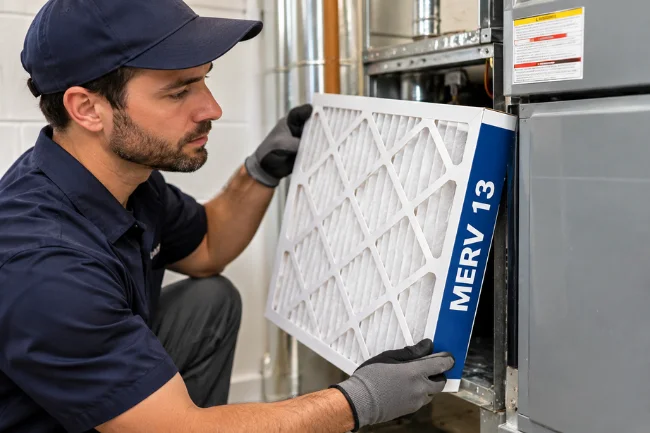
MERV stands for Minimum Efficiency Reporting Value, a rating of a filter’s ability to capture particles in specified size ranges under test conditions. For many homes, the EPA recommends MERV 13 or the highest rating the HVAC system can accommodate.
It is tempting to buy the filter with the biggest number. I would resist that shortcut. A filter that creates excessive resistance can reduce airflow, affect comfort, and place extra demands on equipment. A qualified HVAC technician can check static pressure, blower capability, filter dimensions, and whether a larger media cabinet would provide a better fit.
Check the Filter Seal and Duct Layout
Air follows the easiest route. If the filter fits loosely or air leaks around its edges, some air may bypass the media entirely. A tightly fitted filter and a properly sealed housing can matter as much as a fancy efficiency label.
I would also ask whether all bedrooms are connected to the same return-and-supply network. A renovated room with a separate mini-split, for instance, may not benefit from a central filter elsewhere in the house.
Ask How Much Filtered Air Actually Reaches Living Spaces
Here is a practical way to think about performance: filtration depends on both how efficiently particles are captured per pass and how much air moves through the filter over time.
Imagine two otherwise similar homes. One has a high-efficiency filter but a fan that rarely runs. The other has a compatible filter and a thoughtfully managed circulation schedule. The second home may achieve more useful filtration even without advertising a higher particle-capture percentage.
This is an illustration, not a prediction of a particular home’s air-quality results. Actual performance also depends on incoming pollution, room mixing, leakage, and occupant activities.
The Hidden Coverage Gaps I Would Check Before Buying
I find it helpful to make an “air exposure map” of the house. Mark pollution sources, such as a kitchen stove, nearby traffic, or a fireplace. Then identify the busiest rooms and those connected to central ducts.
Ask where return air enters the system, which doors stay closed, and whether the fan runs during pollution peaks. These details may reveal that a bedroom purifier, better range hood, or improved return airflow is more useful than an expensive central unit.
For example, if cooking causes brief particle spikes, a vented range hood addresses pollution near its source. Central filtration can then help capture some of the particles that escape into the rest of the home. Those jobs complement each other; they are not substitutes.
What a Whole-House Air Purifier Cannot Fix
Moisture, Mold, and Damp Building Materials
A filter may catch airborne mold spores, but it cannot dry a wet wall or stop a roof leak. Persistent musty smells call for moisture inspection, repairs, and safe cleanup. The EPA generally recommends keeping indoor relative humidity around 30–50% to discourage moisture-related problems.
Poor Ventilation and Indoor Gases
Most residential central heating and cooling systems recirculate indoor air rather than routinely supplying fresh outdoor air. Recirculation with a particle filter does not remove carbon dioxide or guarantee adequate ventilation.
Likewise, ordinary particle filtration does not protect against carbon monoxide, radon, or all volatile organic compounds. Use appropriate alarms, testing, exhaust ventilation, and professional remediation for those hazards.
Ozone-Producing Air-Cleaning Gadgets
I would avoid systems marketed around intentional ozone generation. Ozone can irritate the lungs, and the EPA advises against ozone generators in occupied spaces. For technologies such as ionization or plasma cleaning, ask for credible evidence of both effectiveness and byproduct safety rather than relying on broad claims.
Maintenance, Running Costs, and Signs of Trouble
Budget for installation, replacement media, blower electricity, and periodic service—not just the purchase price.
Follow the manufacturer’s replacement instructions, but also consider actual operating hours and local dust conditions. A home near construction or wildfire smoke may load filters differently from a home in a cleaner area.
Warning signs include unusually weak supply airflow, whistling around the filter housing, rooms that no longer heat or cool evenly, or a filter that appears damaged or poorly seated. Those symptoms deserve a check rather than automatically switching to an even denser filter.
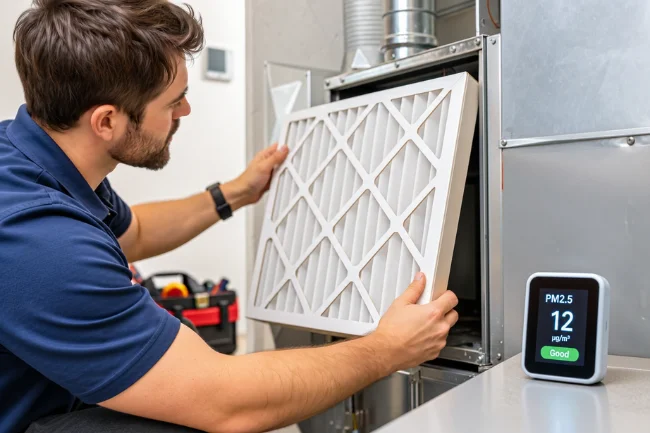
One final caution: a low-cost consumer PM2.5 monitor may help spot patterns, such as cooking peaks or changes after a filter upgrade, but readings vary by device. I would compare similar conditions over several days rather than judge success from one impressive number. Also, a PM2.5 reading cannot tell you whether carbon monoxide, radon, or gaseous pollutants are present.
Is Whole-House Filtration Worth It for Your Home?
It is a strong option when you already have compatible central ductwork, want to address airborne particles across several rooms, and are prepared to maintain the system. It may be less compelling in a small apartment, a home with separate ductless units, or a household concerned mainly about pollution in one bedroom.
Before getting a quote, I would identify my main concern, check the existing filter rating, and ask an HVAC professional about airflow compatibility. Then I would compare a central upgrade with suitable portable devices.
Remember that the largest improvement may come from combining several modest actions: use the kitchen exhaust, keep moisture under control, prevent smoke indoors, clean regularly, and filter the air that continues to circulate.
Final Thoughts
The most meaningful whole house air purifier benefits come from reducing circulating particles across the rooms your HVAC system serves—not from promising perfectly clean air. Start by identifying your home’s main pollution sources, then check filter efficiency, airflow, and fan runtime before choosing equipment. If you are considering an upgrade, ask an HVAC technician to assess compatibility and make sure the solution fits the way your family actually uses the home.
Frequently Asked Questions
Are Whole-House Air Purifiers Worth the Money?
They can be worthwhile for homes with compatible ducted HVAC and particle concerns across several rooms. Value depends on installation costs, fan runtime, and whether a portable unit would meet your needs more economically.
Do Whole-House Air Purifiers Help With Allergies?
They may reduce exposure to airborne pollen, dander, and other particles, but symptom improvement varies. Cleaning fabrics, controlling moisture, and managing known triggers still matter.
Can a Whole-House Air Purifier Remove Cooking Smells?
Standard particle filters do not effectively remove most odor-causing gases. A range hood vented outdoors is usually the better first measure, with suitable gas-phase filtration as a possible supplement.
Should I Run My HVAC Fan Continuously for Cleaner Air?
Longer fan operation generally increases the air passing through a central filter, but it may raise electricity use or affect humidity. Ask your HVAC professional which fan setting suits your system.
Is MERV 13 Enough for a Whole-House Air Purifier?
MERV 13 is a commonly recommended target for particle filtration, provided the HVAC system supports it. Proper fit, airflow, and regular replacement are essential to making that rating useful.
Salman Khayam is the Founder and Editorial Lead at Wellbeing Junction, with 5+ years of experience researching, writing, and reviewing general health and wellness content. He focuses on making complex health topics easier to understand through clear, practical, and evidence-informed information. Salman also oversees editorial quality across the site to help ensure content is accurate, useful, responsibly presented, and supported by reliable sources.