When I look in the mirror, I want to feel confident in my own skin. But for many of us, a softer, looser midsection stands in the way of that feeling. Whether you just went through the beautiful, chaotic journey of pregnancy, successfully smashed your major weight loss goals, or simply noticed that time and gravity are doing what they do best, loose skin around the midsection is incredibly common. If you are searching for effective tummy skin tightening solutions, you have likely realized that the sheer volume of advice out there is overwhelming.
Every influencer claims a magic cream did the trick, while clinics push multi-thousand-dollar lasers, and surgeons point straight to the operating table. It makes you wonder: what actually works, what is a waste of cash, and what is right for your unique body?
I want to break down the science, the treatments, and the lifestyle shifts behind tummy skin tightening. We will look at everything from at-home habits to cutting-edge, non-invasive clinic tech, all the way to surgical realities. No fluff, no medical jargon that requires a degree to understand—just an honest, comprehensive look at how to get your midsection feeling firm, smooth, and toned again.
The Science of Loose Skin: Why Do We Lose Abdominal Firmness?
Before spending a single dime on creams or procedures, we need to understand what we are actually trying to fix. Our skin is a living, remarkably elastic organ, but it has its limits.
The Elasticity Matrix: Collagen and Elastin
The firmness of your abdomen relies almost entirely on two vital proteins found within the dermis (the deep layer of your skin):
Collagen: This provides the structural framework. Think of it as the scaffolding that keeps your skin plump, strong, and upright.
Elastin: This gives your skin its snap-back quality. It allows your abdomen to expand during pregnancy or weight gain and, ideally, return to its original shape afterward.
When the skin is stretched significantly over a prolonged period—such as during a nine-month pregnancy or years of carrying excess weight—those collagen and elastin fibers become frayed and damaged. It is very similar to an elastic band that has been pulled taut for too long; even when you release the tension, it never quite shrinks back to its original, tight dimension.
Crucial Factors Dictating Your Skin’s Snap-Back
Everyone recovers differently, and that variance comes down to a few key biological and environmental factors:
Age: As we cross the threshold of our mid-20s, our natural collagen production drops by about 1% to 1.5% every single year. By the time we hit our 40s or 50s, the skin simply lacks the internal building blocks to snap back autonomously.
The Velocity of Weight Change: If you lose 50 pounds gradually over two years, your skin has time to adapt. If you lose that same weight in six months via bariatric surgery or rapid dieting, the skin cannot keep pace, resulting in a deflated appearance.
Genetics: Look at your parents. DNA dictates how much inherent elasticity your skin possesses and how robust your cellular repair mechanisms are.
Sun Exposure and Smoking: Both UV radiation and nicotine accelerate the breakdown of existing collagen fibers through oxidative stress, severely hindering your tummy skin-tightening efforts.
Setting Realistic Expectations: Loose Stomach Skin vs. Belly Fat
I see people making a fundamental mistake constantly: confusing stubborn subcutaneous fat with loose abdominal skin. It is vital to differentiate between the two because treating loose skin with fat-reduction methods will leave you disappointed, and vice versa.
The Pinch Test for Abdominal Laxity
An easy way to self-assess at home is the pinch test. Gently pinch the area of concern on your abdomen:
If it feels thin, like a deflated balloon or crepe paper: You are primarily dealing with loose skin.
If it feels thick, dense, or pliable like a stick of butter: You are likely dealing with a layer of subcutaneous fat beneath the skin.
If your primary issue is fat, your focus should remain on a sustained caloric deficit and fat-loss protocols. However, if you are at or near your goal weight and the tissue remains wrinkly or loose when you bend forward, you are looking at a true skin laxity issue that requires dedicated tightening strategies.
At-Home Strategies for Mild Tummy Skin Tightening
Let us start with the most accessible strategies. If your skin laxity is mild—perhaps you noticed a slight change after a minor weight fluctuation or early post-pregnancy—at-home interventions can provide a visible boost. While these will not mimic the dramatic results of a surgical lift, they lay the necessary foundation for cellular health.
Targeted Nutritional Support for Firmer Skin
Your body cannot rebuild its structural scaffolding without the correct raw materials. To optimize your tummy skin tightening results from the inside out, your diet should prioritize specific nutrients.
Amino Acids and Protein
Skin is made of protein. Ensuring you hit your daily protein targets provides the building blocks (glycine, proline, and hydroxyproline) necessary for collagen synthesis. Lean meats, fish, eggs, tofu, and bone broth are exceptional sources.
Vitamin C
This vitamin is a mandatory co-factor for collagen production. Without adequate Vitamin C, your body physically cannot convert amino acids into stable collagen fibers. Load up on bell peppers, citrus fruits, kiwi, and dark leafy greens.
Hydration
Dehydrated skin cells are flat and sluggish. When you are chronically dehydrated, your skin loses its natural plumpness, making fine lines, wrinkles, and saggy textures look significantly worse. Aim for consistent hydration throughout the day to keep the dermis functioning efficiently.
Walk down any cosmetic aisle, and you will find dozens of creams promising an instant tummy tuck in a bottle. Let us inject a dose of reality: most over-the-counter body lotions only hydrate the outermost layer of the skin (the epidermis). They cannot physically penetrate deep enough into the dermis to repair broken elastin.
However, a few specific ingredients do have clinical backing for improving skin texture and thickness over time:
Retinoids (Retinol and Prescription Tretinoin): Retinoids are the gold standard in anti-aging for a reason. They speed up cellular turnover and signal the deeper layers of the skin to accelerate collagen production. Applying a retinoid to your abdomen nightly can gradually improve thickness and reduce a crepey texture.
Hyaluronic Acid: This molecule holds up to 1,000 times its weight in water. While it won’t permanently tighten skin, it draws moisture into the tissue instantly, temporarily plumping out fine wrinkles and making the skin look firmer.
Peptides: Copper peptides and palmitoyl pentapeptides act as cellular messengers, sending signals to your fibroblasts to produce more structural proteins.
Exercise: Toning the Muscles Underneath Loose Skin
Exercise cannot directly shrink stretched-out skin tissue because skin is not muscle. However, hypertrophic weight training is a powerful tool for improving the appearance of loose skin.
When you develop and enlarge the muscles underneath your skin—specifically the rectus abdominis, transverse abdominis, and obliques—you create an internal volume shift. The built-up muscle pushes outward against the skin, effectively filling out the loose space, much like blowing air back into a slightly deflated balloon.
Focus on heavy compound movements like squats and deadlifts, supplemented with focused core stability work like planks, bird-dogs, and hanging leg raises. Avoid excessive crunches if you have unaddressed diastasis recti (separation of the abdominal muscles often caused by pregnancy), as this can push the abdominal wall outward and worsen the appearance of the midsection.
If you have optimized your nutrition, built up your core strength, and applied topicals for months without achieving the level of tummy skin tightening you desire, it is time to look at professional, non-surgical in-office treatments. These technologies work by inducing controlled, intentional micro-injuries or thermal stress deep within the dermis, triggering a massive, accelerated healing response.
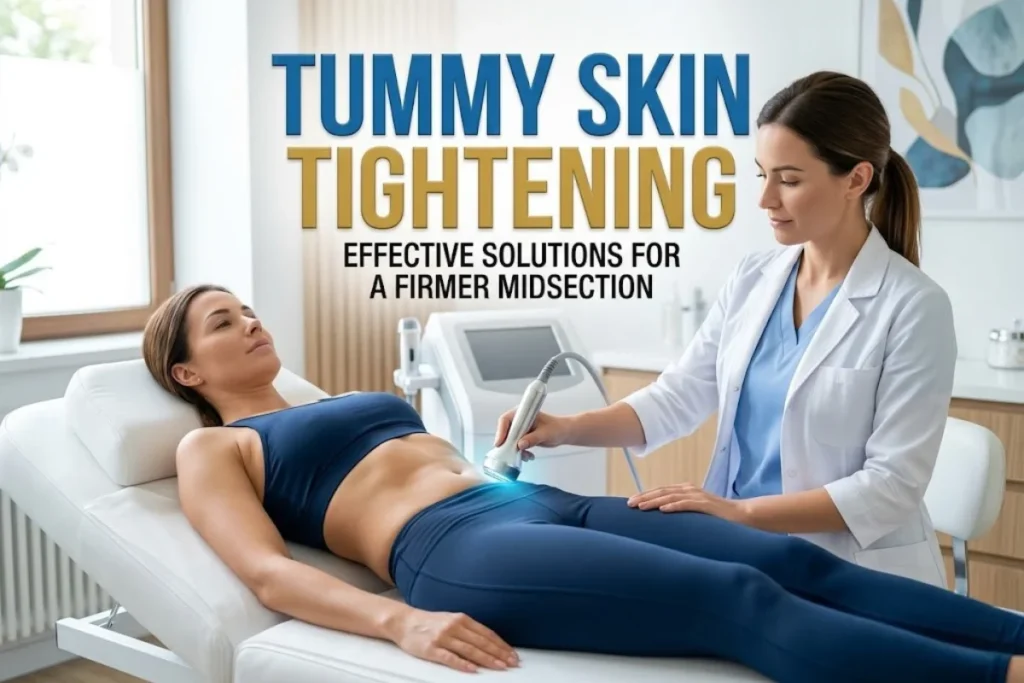
Radiofrequency (RF) Abdominal Skin Tightening
Radiofrequency treatments utilize safe electrical energy to heat the deep layers of your skin to a precise temperature (usually between 40°C and 43°C). When the collagen fibers inside your skin reach this temperature, they instantly contract, providing an immediate tightening effect. More importantly, this thermal energy stimulates fibroblasts to manufacture a wave of fresh collagen over the following three to six months.
Popular systems include Thermage and Exilis. The treatment feels like a warm, deep-tissue massage. There is zero downtime, but you generally need a series of three to six sessions scheduled a few weeks apart to see a significant difference.
High-Intensity Focused Ultrasound (HIFU) for Midsection Sagging
While radiofrequency spreads energy across a broad layer, High-Intensity Focused Ultrasound (such as Ultherapy) delivers highly concentrated micro-focused ultrasound energy to incredibly precise depths—sometimes reaching all the way down to the Superficial Muscular Aponeurotic System (SMAS) layer, which is the same layer surgeons tighten during a traditional facelift.
HIFU is highly effective for moderate skin laxity, but it requires patience. Because it works so deeply within the tissue, the lifting and tightening effect develops gradually over two to four months as your body builds a completely new internal structural matrix.
RF Microneedling: A Powerful Skin Firming Solution
If you want to step up the intensity without undergoing surgery, RF microneedling systems like Morpheus8 or Secret RF are exceptional options.
This procedure combines mechanical microneedling with thermal radiofrequency. Ultrafine needles puncture the skin at customizable depths, and the moment those needles reach their target depth, they emit a burst of radiofrequency energy directly into the tissue. This dual-action approach treats both the superficial texture of the skin (improving stretch marks and crepiness) and the deeper layers responsible for overall sagging.
Be prepared for a few days of mild redness and swelling, but the tissue remodeling results can be profound for non-surgical interventions.
Minimally Invasive Procedures for Loose Midsection Skin
For individuals who have a moderate amount of loose skin but want to avoid the extensive scarring and downtime of major surgery, minimally invasive procedures offer an excellent middle ground. These treatments are typically performed under local anesthesia or light sedation and involve inserting a tiny probe directly beneath the skin layer.
Subdermal Plasma and RF Energy (BodyTite & Renuvion)
Technologies like Renuvion (J-Plasma) and BodyTite have transformed the landscape of modern body contouring and tummy skin tightening.
During a Renuvion procedure, a specialist inserts a thin wand under the skin through tiny, strategically placed incisions. The device simultaneously releases helium gas and radiofrequency energy, creating a precise stream of cold plasma. This energy creates an instantaneous, dramatic contraction of the subdermal connective tissues, effectively “shrink-wrapping” the skin down over the abdominal muscles.
BodyTite uses a similar internal/external probe mechanism to deliver radiofrequency energy, melting localized fat deposits while tightening the skin fibers uniformly. The recovery involves wearing a compression garment for a few weeks, but the downtime is remarkably short compared to a surgical tummy tuck.
Surgical Tummy Skin Tightening: The Gold Standard for Severe Laxity
We must be entirely transparent: if you have a substantial amount of hanging skin—often referred to as an abdominal “apron” or “panniculus” after massive weight loss or multiple pregnancies—non-surgical treatments will not yield the results you are looking for. No laser or cream can make inches of redundant, stretched-out skin vanish. In these scenarios, surgical excision is the only definitive option for meaningful tummy skin tightening.
Abdominoplasty (The Traditional Tummy Tuck)
A traditional tummy tuck is a major surgical procedure designed to address three distinct issues simultaneously:
Excision of Excess Skin: The surgeon removes the apron of loose skin located between the belly button and the pubic hairline.
Diastasis Recti Repair: If your abdominal wall muscles separated during pregnancy or due to visceral fat pressure, the surgeon uses heavy-duty, permanent internal sutures to pull those muscles back together, creating a flat, firm internal corset.
Liposuction: The surgeon often utilizes liposuction to sculpt the flanks and hips, ensuring a balanced, contoured silhouette.
The tradeoff for this dramatic transformation is a permanent hip-to-hip scar, repositioning of the belly button, and a recovery period that requires two to four weeks off work, along with several months of avoiding heavy lifting.
Panniculectomy: Removing Hanging Abdominal Skin
It is important not to confuse a tummy tuck with a panniculectomy. A panniculectomy is performed strictly for medical and functional reasons rather than purely aesthetic goals.
When an individual loses 100 pounds or more, the remaining hanging fold of skin can cause chronic chafing, painful rashes, skin breakdowns, and hygiene challenges. A panniculectomy simply cuts away this hanging apron of skin to alleviate physical discomfort and improve mobility. It does not tighten the underlying abdominal muscles or reshape the belly button. Because it addresses a functional medical issue, it is occasionally covered by medical insurance policies, whereas a tummy tuck is universally categorized as elective cosmetic surgery.
Comparing Your Tummy Skin Tightening Options
Choosing a path forward requires balancing your physical starting point, your budget, and how much downtime you can afford. The following table provides a clear overview of how the most popular options compare against one another.
Treatment Modality
Target Laxity Level
Typical Cost Range
Primary Recovery Time
Longevity of Results
Topicals & Nutrition
Very Mild / Prevention
$20 – $150 per month
None
Temporary (requires continuous use)
Radiofrequency (e.g., Thermage)
Mild to Moderate
$1,500 – $3,500
Zero
1 – 2 Years (requires maintenance)
RF Microneedling (e.g., Morpheus8)
Mild to Moderate
$2,000 – $4,450
3 – 5 Days of redness
1 – 3 Years (benefits from maintenance)
Subdermal Plasma (Renuvion)
Moderate
$4,000 – $8,000
1 – 2 Weeks
Long-lasting (years, subject to aging)
Abdominoplasty (Tummy Tuck)
Severe
$8,000 – $15,000+
3 – 6 Weeks
Permanent (barring future weight shifts)
Long-Term Maintenance After Tummy Skin Tightening
Whichever path you choose—whether you commit to a dedicated at-home regimen or invest in surgery—maintaining your results requires long-term lifestyle alignment. Skin cells continuously turn over and react to their environment, meaning your habits dictate how long your stomach remains firm.
Weight Stability for Lasting Elasticity
The quickest way to undo the benefits of any tummy skin tightening treatment is a significant weight fluctuation. Gaining weight stretches the newly formed or surgically tightened collagen matrix all over again, and subsequently losing that weight will leave you right back at square one. Focus on establishing sustainable, lifelong nutritional habits before investing heavily in advanced skin treatments.
Minimizing Dermal Breakdown Through Health Habits
Chronic systemic inflammation accelerates cellular aging and compromises the integrity of your skin tissue. You can mitigate this by keeping your cortisol levels in check through proper sleep hygiene, limiting refined sugars and ultra-processed oils, and keeping yourself consistently active. A healthy body inside naturally reflects a healthier, more vibrant dermal layer outside.
FAQs On Tummy Skin Tightening
1- Can lifestyle changes completely reverse severe loose stomach skin?
No, lifestyle changes like diet and exercise cannot completely reverse severe loose skin where the internal structural elastin fibers have completely ruptured. Surgery is typically required to remove massive amounts of redundant skin tissue.
2- How long does it take to see results from non-surgical tummy skin tightening treatments?
While you may notice immediate tissue contraction from radiofrequency treatments, true results develop gradually over two to six months as your body builds new collagen fibers.
3- Will losing more weight help tighten the remaining loose tummy skin?
No, if you are already near your goal weight, losing more weight can actually deflate the area further and make the remaining skin look looser and more wrinkled.
4- Is the tummy skin tightening achieved through surgery permanent?
Yes, the surgical removal of excess skin is permanent, though your remaining skin will continue to age naturally and can stretch again if you experience major weight gain or future pregnancies.
5- Can professional microneedling treatments effectively eliminate deep stomach stretch marks?
Microneedling cannot completely eliminate deep stretch marks, but it can significantly improve their texture, depth, and overall coloration by stimulating targeted collagen production within the scarred tissue.
Taking the Next Step
Addressing loose abdominal skin is a deeply personal journey that requires patience, consistency, and a clear understanding of your body’s physiology. There is no shame in having loose skin—it is a tangible reflection of incredible life events, from bringing new life into the world to reclaiming your physical health through weight loss.
If you are ready to explore your options further, I highly recommend scheduling a comprehensive consultation with a board-certified dermatologist or a plastic surgeon. A professional evaluation will help you accurately gauge your level of tissue laxity, cut through the marketing hype, and design a tailored roadmap that aligns with your budget, lifestyle, and aesthetic goals. Take it one step at a time, treat your body with grace, and choose the path that makes you feel most empowered in your own skin.
Citations and Clinical Insights:
Journal of Dermatologic Surgery: Clinical evaluations of radiofrequency and thermal energy on dermal remodeling.
American Society of Plastic Surgeons (ASPS): Procedural insights and statistics regarding abdominoplasty and minimally invasive tissue contraction.
WELLNESS NOTESBetter Health
Simple weekly tips
WELLNESS UPDATES
Get Simple Wellness Ideas Every Week
Practical health, dental care, beauty, skin care, nutrition and personal growth tips delivered straight to your inbox.
No spam. Just useful wellness ideas and healthy living guidance.
Irfan Ali is the founder of Wellbeing Junction, where he specializes in synthesizing peer-reviewed research into actionable lifestyle guides. By bridging the gap between scientific data and daily habits, Irfan Ali provides evidence-based strategies for skin health, nutrition, and personal growth. Follow his work for trusted, human-first wellness advice.