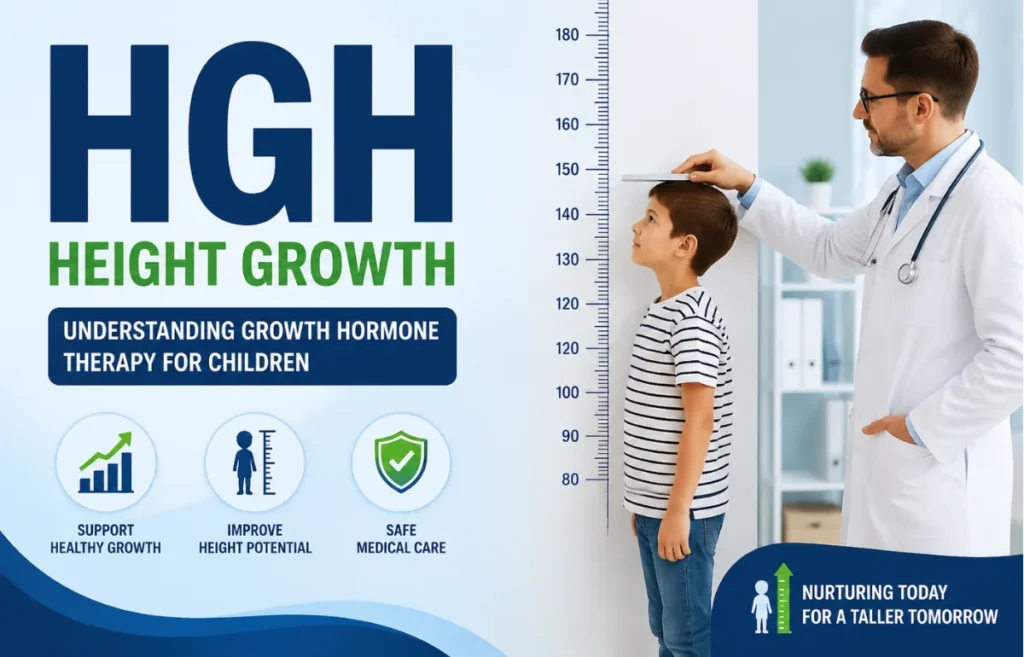
If you’ve been researching HGH height growth, chances are you’ve noticed your child isn’t growing as quickly as expected. Maybe your pediatrician mentioned a slowing growth curve, or perhaps your child is consistently one of the shortest students in class. These concerns often lead families to ask whether human growth hormone (HGH) therapy can help.
The answer depends on the underlying cause of slow growth. HGH therapy can be highly effective for certain pediatric conditions, but it is only recommended after a comprehensive medical evaluation.
Human growth hormone is a naturally occurring hormone released by the pituitary gland. Throughout childhood, it helps regulate normal height growth by stimulating the growth plates in bones through the production of insulin-like growth factor-1 (IGF-1).
When growth hormone production is inadequate—or when another medical condition interferes with growth—a child may experience reduced growth velocity and short stature.
Understanding HGH Height Growth
The phrase HGH height growth refers to the increase in linear height that may occur when children with medically diagnosed growth disorders receive recombinant human growth hormone therapy.
Rather than creating unnatural growth, treatment is intended to restore a healthier growth rate, so children have the opportunity to reach their genetically expected adult height whenever possible.
When Should Parents Be Concerned?
Children grow at different rates, but certain patterns deserve further evaluation.
Parents should discuss growth concerns with a healthcare provider if their child:
Grows less than expected from year to year
Drops across height percentiles
Appears significantly shorter than classmates
Shows delayed signs of puberty
Has a delayed bone age
Was born small and has not experienced catch-up growth
Has a family history of endocrine disorders
An evaluation helps determine whether growth is a normal variation or the result of an underlying medical condition.
Conditions That May Benefit From HGH Therapy
Growth hormone therapy may be appropriate for children diagnosed with certain medical conditions, including:
Growth hormone deficiency
Turner syndrome
SHOX deficiency
Chronic kidney disease
Children born small for gestational age without catch-up growth
Prader-Willi syndrome
Selected children with idiopathic short stature
Treatment recommendations are based on established medical criteria rather than height alone.
How Doctors Evaluate Growth
Before prescribing HGH, physicians complete a thorough assessment.
Growth Records
Previous height measurements are reviewed to calculate growth velocity and identify changes over time.
Families researching HGH height growth can also explore HGH for Children to Grow Taller, where you’ll find information about candidacy, diagnostic testing, treatment expectations, and long-term monitoring for children receiving HGH therapy:
No. Growth hormone therapy is most effective for children with medically diagnosed conditions that affect normal growth.
Can treatment begin before puberty?
Yes. In many cases, earlier treatment offers a greater opportunity because growth plates remain open for a longer period.
How is progress measured?
Doctors monitor growth velocity, height percentile, bone maturation, and overall health throughout therapy.
Can genetics still limit final height?
Yes. Even with successful treatment, genetics remains one of the strongest influences on adult height.
Why is a comprehensive evaluation important?
Proper testing helps determine whether slow growth is caused by hormone deficiency, delayed puberty, genetics, chronic illness, or another condition requiring a different treatment approach.
Final Thoughts
Learning about HGH height growth is an important step for parents concerned about their child’s development. Although human growth hormone therapy is not appropriate for every child with short stature, it can significantly improve growth in children with specific medical conditions. A complete growth evaluation provides the information needed to develop an individualized plan and helps families make confident decisions about their child’s future growth.
WELLNESS NOTESBetter Health
Simple weekly tips
WELLNESS UPDATES
Get Simple Wellness Ideas Every Week
Practical health, dental care, beauty, skin care, nutrition and personal growth tips delivered straight to your inbox.
No spam. Just useful wellness ideas and healthy living guidance.
Irfan Ali is the founder of Wellbeing Junction, where he specializes in synthesizing peer-reviewed research into actionable lifestyle guides. By bridging the gap between scientific data and daily habits, Irfan Ali provides evidence-based strategies for skin health, nutrition, and personal growth. Follow his work for trusted, human-first wellness advice.